Can You Put New Flooring Over Tile?

Yes. You can lay click vinyl plank, laminate or engineered wood over ceramic tile, as long as the tile is firmly bonded, the floor is flat to within 3/16 inch over 10 feet, and the grout lines are filled. You skip demolition, which costs $2 to $7 per square foot. The price you pay is height: the new floor sits on top of the old one, so doors and thresholds need attention.
Which floors can go over tile
Floating floors are the usual choice, because they are not glued to the tile and can bridge it. The table lists what the manufacturers' own installation guides ask for.
Flooring over existing tile: what the installation guides require
| Floor type | Over tile? | What the guide asks for | Source |
|---|---|---|---|
| 1Click vinyl plank (LVP / rigid core) | Yes | Fill the grout lines with a cement-based levelling compound; floor flat to 3/16" in 10 ft | COREtec installation guide |
| 2Laminate | Yes, on a flat floor | No more than 3/16" unevenness per 10 ft; fill depressions with levelling compound | Mohawk installation guide |
| 3Engineered wood (floating) | Check your product's guide | Flatness as above; lower heat limits over radiant floors | Hallmark radiant heat guide |
| 4New tile over old tile | Yes, with a recognised method | Existing tile properly installed, in good condition and able to carry the new layer | NTCA TileLetter, Jan 2025 |
Requirements taken from manufacturers' installation guides. Scroll sideways on mobile →
The three checks before you buy anything
Most failed jobs come from skipping one of these. Each takes a few minutes.
Check the tile, the flatness and the grout
- Is the tile solid? Walk the room and press on each area. Tiles that rock, sound hollow or have cracked loose must be fixed or removed first: a floating floor will copy the movement.
- Is the floor flat? Lay a long straightedge on the floor. Both COREtec and Mohawk set the limit at 3/16 inch over 10 feet (COREtec also gives 1/8 inch over 6 feet). High spots get ground down, low spots get filled.
- How deep are the grout lines? Wide or deep joints show through thin vinyl over time, an effect installers call telegraphing. COREtec's guide says to fill grout lines with a latex-fortified cement levelling compound.

The room before the floor change
The height problem: doors, thresholds and appliances
A new floor on top of tile raises the finished level by the thickness of the plank plus any underlay. That has three practical consequences. Door frames need to be undercut so the plank slides underneath; Mohawk's guide asks for at least 1/4 inch under the frame and the wall base. Doors may need trimming at the bottom. And where the new floor meets a room you are not changing, you need a transition strip to manage the step.
Check the kitchen before you commit. A dishwasher or range that slides under a countertop has limited clearance, and a raised floor in front of it can trap the appliance in place. Measure the gap first.
Bathrooms and radiant heat
Both are possible, with conditions set by the manufacturer. In wet areas, COREtec asks for the perimeter to be caulked with flexible silicone, and Mohawk asks for 100% silicone on the entire perimeter of a laminate floor and says it should not be installed in rooms with floor drains or sump pumps. Over radiant heat, COREtec's limit is 85°F at the surface; Hallmark's guide for engineered wood sets 80°F.
When you should not cover the tile
Covering is the wrong answer in a few situations.
Stop and deal with the cause first
- Loose, hollow or cracked tiles across the room. The new floor needs a stable base.
- Moisture coming up through the floor. Covering it hides the problem and traps it.
- A floor that is already too high. If doors, stairs or appliances have no clearance left, removal is the cleaner route.
- Old resilient flooring under or beside the tile. The CPSC lists vinyl-asbestos floor tiles, the backing on vinyl sheet flooring and floor-tile adhesives among materials that may contain asbestos. The EPA's advice is not to sand or level such flooring and, where it needs replacing, to install the new floor covering over it if possible. If you are unsure what is under your floor, have it tested before you disturb it.
What it costs in 2026
The saving comes from skipping demolition. Published 2026 figures give a sense of scale; get a local quote before you decide.
US price ranges, 2026
| Item | Published range | Source |
|---|---|---|
| 1Removing a tile floor | $2 to $7 per sq ft, typically $3.50 | HomeAdvisor, June 2026 |
| 2Vinyl plank, material | $2 to $7 per sq ft (standard) | This Old House, June 2026 |
| 3Vinyl plank, installation | $3 to $10 per sq ft | This Old House, June 2026 |
| 4Engineered hardwood | $5 to $20 per sq ft | HomeAdvisor, June 2026 |
Figures as published by the sources named, mid-2026. Scroll sideways on mobile →
Removal also costs time. HomeAdvisor puts hand removal at 8 to 12 hours per 100 square feet. By comparison, This Old House reports that a professional vinyl plank installation takes one to two days.
See the new floor in your room before you buy
The decision that is hardest to reverse is the look. A plank sample on the floor tells you little about a whole room: the colour shifts with your light, your walls and your furniture. Styly's floor visualizer shows your own room with a different floor from a single photo, so you can compare a light oak, a darker wood and a stone look side by side before you order.
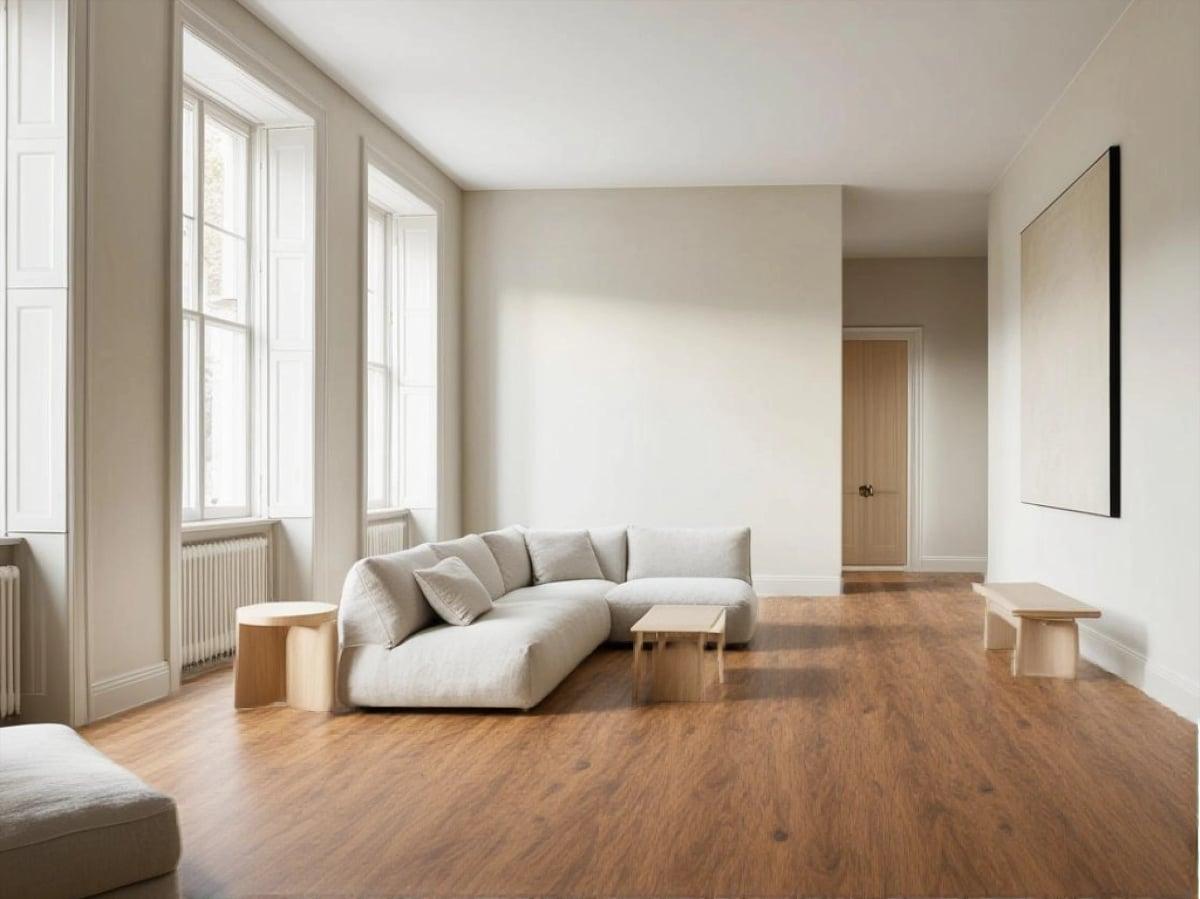
The same room with a different floor, visualised with Styly
Try a new floor on a photo of your room
Upload a photo and compare floors in your own space. The floor and wall visualizer is included in Styly Starter, which starts with a 7-day free trial.
Try Styly →New flooring over tile: FAQ
Can you put vinyl plank flooring over tile?
Yes. COREtec's installation guide covers it: the floor must be flat to 3/16 inch in 10 feet, grout lines should be filled with a latex-fortified cement levelling compound, and ceramic tile should be abraded where adhesion is needed.
Do I need to fill the grout lines first?
On most tile floors, yes. Unfilled joints can show through the new floor over time. A cement-based levelling compound brings the surface flush.
How flat does the floor have to be?
Both COREtec (vinyl) and Mohawk (laminate) set a limit of 3/16 inch of unevenness over 10 feet. Grind high spots and fill low ones before you start.
Can I do this in a bathroom?
Often, if the product is rated for it. Manufacturers ask for a flexible silicone seal around the perimeter, and Mohawk excludes rooms with floor drains for its laminate.
Does it work over radiant floor heating?
Usually, within the manufacturer's temperature limit. COREtec states a maximum operating temperature of 85°F; Hallmark's engineered wood guide sets 80°F at the surface.
What if there is old vinyl or asbestos under the floor?
Do not sand or scrape it. The EPA advises against sanding or levelling asbestos flooring and recommends installing new floor covering over it where possible. Have suspect material tested by a qualified professional.
How much does removing tile cost instead?
HomeAdvisor's June 2026 figure is $2 to $7 per square foot, with $3.50 typical, and 8 to 12 hours of work per 100 square feet by hand.
How this guide was put together
Every limit and price above comes from the source named beside it, read in October 2026: manufacturers' installation guides for the technical limits, US government pages for asbestos, and published cost guides for prices. We did not test installations ourselves. Your product's own guide takes priority over anything written here, so read it before you start.
Source: COREtec installation guide
Source: CPSC: asbestos in the home